

How Did Franklin D Roosevelt Court Packing Plan Seek To Change The Makeup Of The Surpreme Court
 The Great Depression of the 1930s was the nation's grimmest economic crunch since the founding of the American republic. Later the 1932 elections, Franklin D. Roosevelt introduced a series of innovative remedies—his New Deal—but the entire recovery effort seemed threatened when the U.s. Supreme Courtroom invalidated pregnant pieces of its legal foundation. Eventually Roosevelt proposed his and so-called "court-packing" bill to circumvent the Court's unfavorable rulings. The events that followed qualify as 1 of the stranger chapters in the ramble history of the United States.
Roosevelt brought relentless energy and creativity to Washington post-obit his election in 1932. The bug before him were unprecedented in depth and scope. Since the crash of the stock market three years earlier, v thousand banks had failed, wiping out over nine million accounts. At least 25 percent of the work force was unemployed; national income was less than half what it had been in 1929. In the first hundred days of the new administration, Roosevelt and his squad of advisors attacked the crunch with a panoply of legislative measures—an emergency banking act, a series of employment relief acts, a bill to refinance defaulted mortgages, and laws shoring up agronomics and regulating Wall Street. New instrumentalities of government were conceived—among others, the Agricultural Adjustment Administration (AAA), the Public Works Administration (PWA), and the National Recovery Administration (NRA)—thereby introducing the "alphabet agencies" that soon became a familiar feature of the New Deal.
Despite the widespread popularity of these initiatives, Roosevelt faced opposition from several quarters, including well-nigh of the nation's newspaper publishers, many business and financial interests, entrenched states'-rights supporters, and advocates of small government. Since the Golden Age of the 1890s, those forces had controlled America'southward economic establishment and, later on a brief eclipse during the progressivism of the Theodore Roosevelt and Woodrow Wilson administrations, they had assumed renewed primacy during the 1920s. Bolstering their position was a legal regime overseen by the Us Supreme Court. In a line of cases following the end of Reconstruction, the Court had built a doctrinal superstructure conducive to modern laissez-faire industrialism and hostile to the claims of laborers and the indigent. Legal concepts like noun due process had exalted private holding and freedom of contract while limiting the ability of government to regulate or otherwise interfere with entrepreneurship.
Roosevelt anticipated a recalcitrant Supreme Court when he took office. He had criticized information technology even earlier his election, noting during his presidential campaign that the Courtroom was "in the complete control" of the Republican Political party and thus implicitly an instrument of laissez-faire. The emergency measures of the new administration's start hundred days were developed without illusions about the Court's ability to stymie them. Several decisions during the previous decade had applied substantive due procedure—the idea that certain rights (such equally property rights) are then fundamental as to exist beyond governmental regulation—to strike down country laws that regulated businesses by imposing actress costs upon them, for example, through minimum wages or condom rules. Shortly prior to the 1932 election, as if in alert to Roosevelt, the Court had invalidated on noun due procedure grounds an Oklahoma law requiring the licensing of water ice-making facilities. A wall seemingly had been installed around individual business and government told to keep out.
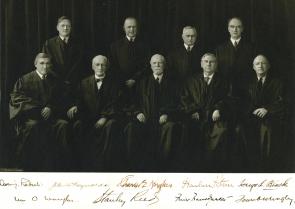
Of particular concern to the New Dealers was a four-judge coterie on the Court, Justices Butler, McReynolds, Sutherland, and Van Devanter, who collectively embraced a settled anti-regulatory ideology hostile to interventionist government. Each of the so-called Four Horsemen was over the historic period of seventy in 1932. All four regularly voted in a block wherever substantive due process or delegation of powers problems were implicated, needing merely a unmarried recruit from the remaining five justices to defeat governmental initiatives that burdened private enterprise. The other justices were less predictable. Justice Brandeis, the eldest, was a Wilson appointee with potent progressive leanings but a predilection for express government and modest business. The primary justice, Charles Evans Hughes, a more than bourgeois figure, had withal served as governor of New York and was open up-minded about regulation. Two other New Yorkers, Justices Cardozo and Stone, were genuine intellectuals who brought both compassion and respect for prior precedent to their deliberations. Owen Roberts, the youngest of the justices, was a career prosecutor and a 1930 Hoover appointee from Pennsylvania (at age fifty-eight) with no prior involvement in whatsoever legislature or concern and thus an unknown on the constitutional problems of the mean solar day. His vote soon turned out to be critical.
During the start twenty-4 months later on Roosevelt was elected, his assistants successfully steered clear of direct confrontation with the Supreme Court. Meanwhile, two 5-4 decisions by the Court in 1934 upholding land-based regulations hinted that a majority of the justices were sensitive to the emergency. Significantly, Roberts had voted confronting the Four Horsemen in both cases, and in 1 of them, Nebbia five. New York, he had written the majority opinion upholding price controls on the auction of milk. The resulting sense of relief among broken-hearted New Dealers, however, proved premature. In January 1935, the Court issued its first ruling on a New Deal statute, striking down a provision of the National Industrial Recovery Act (NIRA) that had imposed new controls on the product and pricing of oil. The vote was an overwhelming 8-1 against the New Deal mensurate.
The decision in the "Hot Oil" case was the first of a series of devastating losses for the Roosevelt legislative program in the Supreme Court. Later on surviving (by a 5-4 margin) a challenge to the government's currency regulation powers in the "Golden Clause" cases, the Administration saw its Railroad Retirement Human activity invalidated five-4, with Roberts joining the 4 Horsemen in declaring the law unconstitutional. Shortly thereafter, on "Blackness Monday," May 27, 1935, the Court issued 3 destructive decisions—Schechter Poultry (the infamous "sick chicken" instance) cut the heart out of the NIRA, Louisville Bank struck downward the Frazier-Lemke Act limiting mortgage foreclosures, and Humphries' Executor scaled back the President's ability to command the make-up of certain federal regulatory bodies. Each of the decisions was unanimous. Subsequent rulings included the invalidation of the wages-and-hours and price-control mechanisms of the Bituminous Coal Conservation Deed (5-4, with Roberts the swing vote), invalidation of the processing tax in the Agronomical Adjustment Human activity (6-three, with Roberts writing for the bulk), and vacatur of a New York State minimum wage law (5-4, Roberts again), a ruling with worrisome implications for a vast area of industrial regulation.
Roosevelt and his supporters looked on aghast at the path of destruction these decisions wreaked upon economic regulation more often than not and the New Deal in particular. Attorney General Homer Cummings wrote privately, echoing the views of many in the administration and throughout the country, "I tell y'all, Mr. President, they hateful to destroy the states. . . . We will have to discover a way to get rid of the present membership of the Supreme Courtroom." Roosevelt himself kept his public criticisms limited and his plans shut to the vest, although soon afterwards Schechter he observed at a press briefing, "Nosotros accept been relegated to the equus caballus-and-buggy definition of interstate commerce." Even Herbert Hoover was reported equally suggesting a constitutional amendment to restore at least to the states "the ability they thought they already had."
Amending the Constitution, logical as it might seem, was not the remedy favored by those whom Roosevelt put to work exploring ways around the Court's obstructions. It was not but a thing of finding the right diction and getting information technology through Congress or a constitutional convention. Equally one of the young brainstormers, Thomas Corcoran, observed to Harold Ickes, a Roosevelt advisor, there were also many states "that would naturally exist against a broadening subpoena or in which money could be used to defeat it." There was thus talk of instead limiting past statute the Court's power to invalidate legislation. Numerous such bills had been introduced in Congress following the Court'due south assault on progressive-era legislation during the 1920s, and Roosevelt's congressional allies continued the process post-obit the most recent Court reversals. Just even after the overwhelming victory past Roosevelt and the Democrats in the 1936 elections, the prospects of jurisdictional limitation seemed doubtful, peculiarly if the Courtroom itself could ultimately dominion on its constitutionality.
The most obvious other alternative was to change the limerick of the Court. Getting the near elderly justices to retire and appointing friendly replacements would have been the ideal curative. Indeed, Van Devanter and Sutherland had both indicated their wish to retire, but the administration'due south 1933 Economy Neb cutting pension benefits had ironically discouraged these two scourges of the New Bargain from voluntarily stepping downwardly. Whatever attempt to compel retirement by legislative fiat would run up against the life tenure protection in Article Three of the Constitution, so the mandatory removal approach was eventually discarded.
In that location remained the possibility of changing composition by increasing the size of the Court through congressional act. Extensive precedent existed for such a motion. Article 3 of the Constitution, which establishes the judicial branch, does non prescribe the number of justices on the Supreme Courtroom. The Founders left that detail to legislation. Congress in the first Judiciary Act (1789) had set the number of Supreme Court seats at half-dozen. Thereafter, the number had varied from five (1801) to 7 (1807) to 9 (1837) to ten (1863) back to 7 (1866) and finally to 9 over again (1869). In January 1937, Attorney General Cummings privately showed Roosevelt a formula that would link an increase in the size of the Courtroom to the number of incumbent justices who reached the historic period of seventy and declined to retire, capped at a maximum of six new justices. The idea had been suggested past Edwin Corwin, a Princeton political scientist, who himself had received information technology from a government professor at Harvard, Arthur Holcombe. (The complex genesis of the program is definitively mapped out in William Leuchtenberg, The Supreme Court Reborn [Oxford, 1995].) This approach appealed strongly to the President and became the core of the programme he ultimately advanced.
On February 5, 1937, Roosevelt sent his courtroom-packing bill to Congress in the form of proposed legislation to "reform" the judiciary generally. His accompanying argument was framed not in terms of an obstructionist Supreme Court just rather every bit a response to overcrowded federal court dockets and the special problem occasioned by constitutionally imposed judicial life tenure, i.e., "the question of aged or infirm judges—a subject field of delicacy yet one which requires frank discussion." The President pulled no punches, bemoaning that a decline in "mental or physical vigor leads men to avoid an examination of complicated and changed weather condition." He added, "older men, assuming that the scene is the same every bit it was in the past, terminate to explore or enquire into the present or the future." Thus, under the proposed new police, when any federal judge (non only on the Supreme Courtroom) with at least 10 years' service remained on the demote for more than than six months later on reaching the historic period of seventy, the President could add a new judge to that court. The maximum was six new justices for the Supreme Court and forty-four for the rest of the federal judicial system.
The small group of advisors who had secretly worked with Roosevelt in developing the bill and its rationale—Cummings, Corcoran, Stanley Reed, Samuel Rosenman, and Donald Richberg—were among the most constitutionally savvy lawyers in the administration. All were satisfied it met ramble standards. And all causeless the huge new Democratic majority in both houses of Congress, beneficiaries of the President's popularity in the 1936 national elections, would rapidly approve the measure. Roosevelt, however, had miscalculated. By keeping his thinking under wraps until the plan was unveiled, he had done zero to build support behind the scenes amongst legislative allies. While respected administration backers similar Joseph T. Robinson, the Senate majority leader, immediately appear for the bill, others such as Business firm Speaker William Bankhead and House Judiciary Chairman Hatton Sumners resented the surprise and emerged lukewarm or outright hostile. Public sentiment was also largely negative, stirred up by vociferous opposition from a predominantly conservative press. As the weeks passed and the debate intensified, it became clear to the administration that the court-reform bill faced rocky going. Ane matter was certain—Congress would not quickly corroborate information technology.
Then came the unexpected, an changeabout by the Supreme Court. On March 29, 1937, the Court handed downward its conclusion approving a minimum wage law in Washington Land, West Coast Hotel v. Parrish. The margin was five-4, with Roberts voting with the majority. The decision effectively reversed the ruling that had invalidated New York's like wage law the previous June. Two weeks later, Roberts was on the winning side in five major decisions upholding the National Labor Relations Act. On May 24, the Court constitute the Social Security Act and related country legislation constitutional with the aforementioned five-homo majority, supported surprisingly in i of the decisions by two of the Four Horsemen, Sutherland and Van Devanter. By this time, Van Devanter had announced his intention to retire, and information technology was articulate Roosevelt would presently be able to appoint a new justice of his selection without whatever need for court-packing.
Meanwhile, the legislative prospects of the reform bill grew increasingly dimmer. When Vice President John Nance Garner every bit presiding officer of the Senate refused to support the bill, and when the Senate Judiciary Commission (dominated by Democrats) disapproved information technology, the proposal sustained a knockout dial. In July information technology was recommitted from the Senate floor to the Committee, where it was transformed into a minor procedural law. The compositional element died. New Dealers could always say their court-packing program was never actually voted down, but the reality was clear—the proposal had lost its momentum, was deeply unpopular, and for all practical purposes was soundly defeated.
Yet on the doctrinal front, the assistants had won the war. Beginning with Parrish, the decisions of the Supreme Courtroom upholding government'southward power to regulate set the pattern for the remainder of Roosevelt's presidency and for nearly a half century thereafter. The ideology that had stymied the New Deal and parallel state legislative efforts to control private economical relationships went into eclipse. The Court had gone through what some commentators have described every bit a "constitutional revolution." Yet the apparent stimulus for turn-almost was widely attributed to the court-packing initiative, which had ironically constituted 1 of Roosevelt's most embarrassing defeats.
Several other facts reinforced the irony. Many contemporary observers noted the timing of Justice Roberts's apparent reversal from a swing voter against regulatory legislation to a swing voter in favor of information technology, a dramatic change described famously every bit the "switch in time that saved nine." By all indications, Roberts had been influenced by the court-packing neb. The facts, however, are more complex. Roberts really rendered his critical vote in the Parrish case at least two months before Roosevelt announced his plan. Chief Justice Hughes had delayed releasing the determination to accommodate Justice Rock, who had been temporarily out of action due to affliction. Moreover, Roberts had never shared the substantive due procedure ideology of the Iv Horsemen. As he stated in his 1934 Nebbia decision for the 5-4 majority upholding New York's controls on milk prices: "Neither property rights nor contract rights are accented." If that was Roberts's view nearly three years before the court-packing initiative, something else must take been going on in all those decisions that had rejected then much of the New Deal's regulation.
Nether scrutiny, the modify in the Supreme Court's outlook emerges as a peculiar affiliate in a complicated story, with more twists to it than a elementary switch past a swing man in reaction to Roosevelt's plan to pack the Courtroom. Equally the legal historian Barry Cushman has persuasively suggested, constitutional doctrine was already evolving in a direction favorable to a more interventionist part for government well before Roosevelt introduced the court "reform" pecker. Most of the earlier decisions invalidating New Deal legislation were 9-0 or viii-1 rulings, not five-4 squeakers. Those decisions reflected a view shared past even the more progressive justices that the new laws had been sloppily drawn and poorly defended. Roosevelt'due south draftsmen shortly learned from these mistakes and avoided them in subsequent legislation that the Court sustained. While it is certainly true that the eventual breakup and replacement of the Four Horsemen eased the Court in that direction, the fact remains that technically tighter draftsmanship greatly helped the New Bargain cause in the Courtroom's later rulings.
Accordingly, it seems unlikely the court-packing plan played much of a function in inducing the Supreme Courtroom to change direction. On the other mitt, at that place is also niggling incertitude the plan had a harmful effect on Roosevelt'southward legislative program for the balance of the New Deal. Six months after achieving the most 1-sided electoral victory in modern times, the Democrats were divided and in disarray; the unpopularity of the courtroom-packing plan had undermined the President'south moral authority and given lukewarm party members an excuse to abandon him. Never again would the Democratic leadership gather the momentum that had brought such consistent legislative successes during the first four years of the administration. "The whole New Bargain," declared Henry Wallace, "really went up in smoke as a result of the Supreme Court fight."
Perhaps the well-nigh vexing question is why Roosevelt did non just drib the program when the battle with the Courtroom was clearly won. No one knows the respond for sure. A virtually gregarious of presidents, FDR was likewise among the most guarded and inscrutable. Was information technology a misplaced feeling of empowerment derived from the 1936 elections? Was it the sort of internal stubbornness that had won the mean solar day with Congress in the past? Robert H. Jackson, a Roosevelt confidant and hereafter Supreme Court appointee, reached this full general assessment: "The President was not a legalistic-minded person. He was non an economic-minded person. He was a stiff thinker in terms of correct and wrong, for which he frequently went dorsum to quotations from the Scriptures. Certain things simply were non right in his view." Having witnessed and then many rulings by the Supreme Court that, in his view, simply were not correct, Roosevelt had set upon a remedial course that he stuck with to the end. How the drama played out is a written report in the capriciousness of history.
Richard G. Menaker is a partner in the police force firm Menaker and Herrmann, LLP. Special thank you to Albena Petrakov, police clerk at Menaker & Herrmann LLP, for her enquiry on the irresolute composition of the Supreme Court.
Source: http://ap.gilderlehrman.org/history-by-era/new-deal/essays/fdr%E2%80%99s-court-packing-plan-study-irony
Posted by: singletonhimetch.blogspot.com
0 Response to "How Did Franklin D Roosevelt Court Packing Plan Seek To Change The Makeup Of The Surpreme Court"
Post a Comment